Doppel

%20--%3e%3cdefs%3e%3cstyle%3e%20.st0%20{%20fill:%20none;%20}%20.st1%20{%20fill:%20%23fff;%20}%20.st2%20{%20clip-path:%20url(%23clippath);%20}%20%3c/style%3e%3cclipPath%20id='clippath'%3e%3crect%20class='st0'%20width='1500'%20height='330.9'/%3e%3c/clipPath%3e%3c/defs%3e%3cg%20class='st2'%3e%3cg%3e%3cpath%20class='st1'%20d='M490.9,19.1h-79.9v245.2h79.5c78.5,0,129.3-44.5,129.3-124s-50.5-121.2-129-121.2ZM486.3,229.6h-34.7V53.8h34.7c62.4,0,91.5,31.5,91.5,86.5s-29.1,89.3-91.5,89.3Z'/%3e%3cpath%20class='st1'%20d='M728.4,78.7c-51.5,0-92.9,37.5-92.9,93.5s41.3,96,92.9,96,92.9-37.8,92.9-96-40.7-93.5-92.9-93.5ZM728.4,234.9c-31.9,0-54-25.6-54-62.7s21.7-60.2,54-60.2,54,25.2,54,60.2-22.1,62.7-54,62.7Z'/%3e%3cpath%20class='st1'%20d='M934.9,78.7h0,0c-28,0-47.6,12.6-57.1,27.3v-23.1h-37.8v248h37.8v-90.4c10.2,15.8,30.1,27.7,56.4,27.7,45.6,0,84.4-34,84.4-96s-37.8-93.5-83.7-93.5ZM928.6,235.9c-28.7,0-51.5-23.8-51.5-63.7s21.4-61.3,51.5-61.3,50.8,21.4,50.8,61.3-22.4,63.7-50.8,63.7Z'/%3e%3cpath%20class='st1'%20d='M1134.6,78.7h0,0c-28,0-47.6,12.6-57.1,27.3v-23.1h-37.8v248h37.8v-90.4c10.2,15.8,30.1,27.7,56.4,27.7,45.5,0,84.4-34,84.4-96s-37.8-93.5-83.7-93.5ZM1128.3,235.9c-28.7,0-51.5-23.8-51.5-63.7s21.4-61.3,51.5-61.3,50.8,21.4,50.8,61.3-22.4,63.7-50.8,63.7Z'/%3e%3cpath%20class='st1'%20d='M1325.9,78.6h0s0,0,0,0c-46.9,0-90,36.1-90,93.5s42.1,96,92.5,96,73.6-16.8,84.5-55.7h-37.9c-9.1,17.5-27.3,23.5-45.6,23.5-27.7,0-51.2-19.3-54.7-50.8h139.8v-8.7c0-65.1-41.7-97.7-88.7-97.7ZM1274.4,155c3.2-27.7,24.9-44.5,50.8-44.5s47.7,17.5,49.8,44.5h-100.6Z'/%3e%3cpath%20class='st1'%20d='M1473.4,234.3V19.1h-37.8v209.6c0,19.7,16,35.6,35.6,35.6h28.8v-30h-26.6Z'/%3e%3cpath%20class='st1'%20d='M176.7,0v18c39.5,11.3,68.5,47.7,68.5,90.8s-28.9,79.5-68.5,90.8v84.1c66.8-12.7,117.3-71.4,117.3-141.9S243.5,12.7,176.7,0Z'/%3e%3cpath%20class='st1'%20d='M48.8,174.9h0c0-43.2,28.9-79.5,68.5-90.8V0C50.5,12.7,0,71.4,0,141.9s50.5,129.2,117.3,141.9v-18c-39.5-11.3-68.5-47.7-68.5-90.8Z'/%3e%3cpath%20class='st1'%20d='M120.7,93.2l-11.5,67.5,63.5,30.3,11.5-67.5-63.5-30.2Z'/%3e%3c/g%3e%3c/g%3e%3c/svg%3e)
About
Doppel is an AI-native platform focused on detecting and disrupting social engineering attacks. We build systems that identify AI-powered impersonation, phishing, and fraud across the internet, link them into real-time threat graphs, and actively dismantle attacker infrastructure.
Our work combines LLM-driven detection, large-scale threat intelligence, and autonomous response systems with training and simulation to strengthen human defenses. Our mission is to protect the world from social engineering attacks every day.
A challenge for the 3Blue1Brown Audience
At Doppel, every decision comes down to reasoning about p(y) — the probability that a message is malicious given what we observe. Here's a puzzle that captures the core of that challenge.
Setup. You're a cracked security team defending your users against a known
phisher. Each day, the two of you are locked in a cat-and-mouse fight. The
attacker sends a phishing campaign and chooses how often to use each of n
persuasive phrases in their messages — things like "urgent", "verify account",
"free gift", "security alert", "payroll".
The attacker selects a distribution \mathbf{p} = (p_1, p_2, \ldots, p_n) over
phrases T = \{t_1, t_2, \ldots, t_n\}, where
p_i = P(\text{attacker uses } t_i).
Each phrase t_i has an intrinsic social-engineering payoff s_i: if a message
using t_i reaches a user unflagged, it succeeds with probability s_i. If the
message is flagged or fails to convince, payoff = 0.
Your detector. You don't have the bandwidth to inspect every message
perfectly — these phrases appear innocently in normal traffic too. Instead, you
run a lightweight detector that monitors phrase frequencies. Given a baseline
distribution \mathbf{q} = (q_1, q_2, \ldots, q_n) representing natural phrase
frequencies, you raise an alarm when:
\displaystyle \sum_i p_i \log\!\left(\frac{p_i}{q_i}\right) > C
for some constant C. (You might recognize this quantity.)
The question. What distribution \mathbf{p} should the attacker choose to
maximize their expected payoff?
Hint: the optimal strategy isn't deterministic.
Have an answer you feel proud of? When you apply, include a line at the bottom of your resume saying "Answer to 3b1b talent page phishing puzzle" with a link to a short write-up of your solution.
Featured work
Threat Classification with OpenAI RFT
Doppel's threat classification system uses OpenAI's GPT-5 and Reinforcement Fine-Tuning (RFT) to make real-time decisions on whether a detected signal is malicious, benign, or ambiguous. Each signal passes through multiple LLM prompts purpose-built for different threat types — assessing impersonation risk, brand misuse, and social engineering patterns.
The system learns continuously: human analysts review and correct classifications, those corrections fine-tune models via OpenAI's RFT platform, and improved models are redeployed to production. The result is a tightening feedback loop that cut analyst workloads by 80% and reduced threat mitigation from hours to minutes.
Read Full Case Study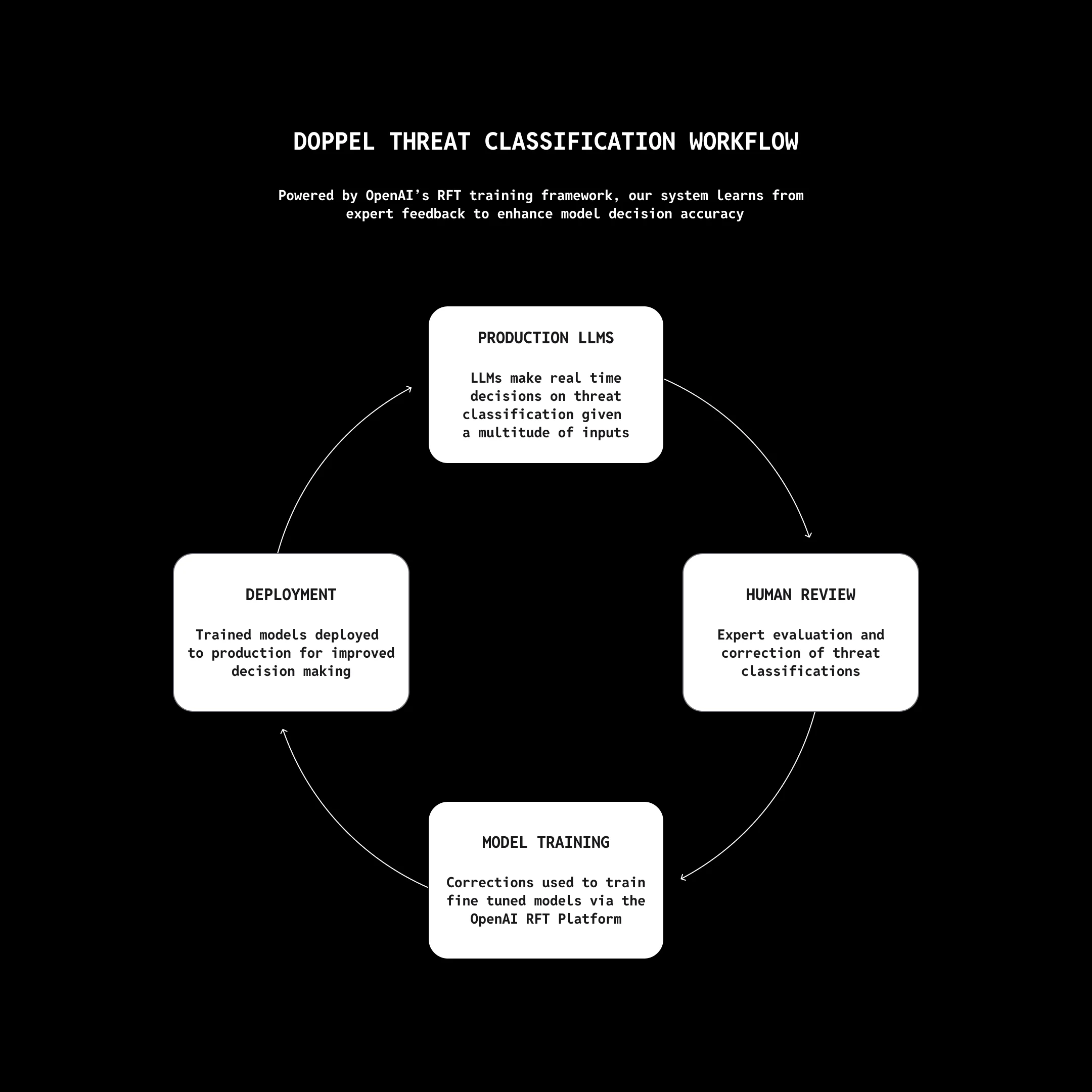
Doppel's threat classification workflow, powered by OpenAI's RFT training framework.
Eliminating ML Infrastructure Tax with Modal
Running ML at scale used to mean managing a maze of Docker builds, Cloud Run services, IAM auth layers, and cold starts — overhead that crowded out the actual modeling work. Doppel replaced that stack with Modal's function-based inference, collapsing multi-step service pipelines into direct function calls.
The result: warm builds dropped from 10–30 minutes to under a minute, the team gained automatic scaling for traffic spikes, and engineers shifted their attention from infrastructure management to model development.
Read Full Write-up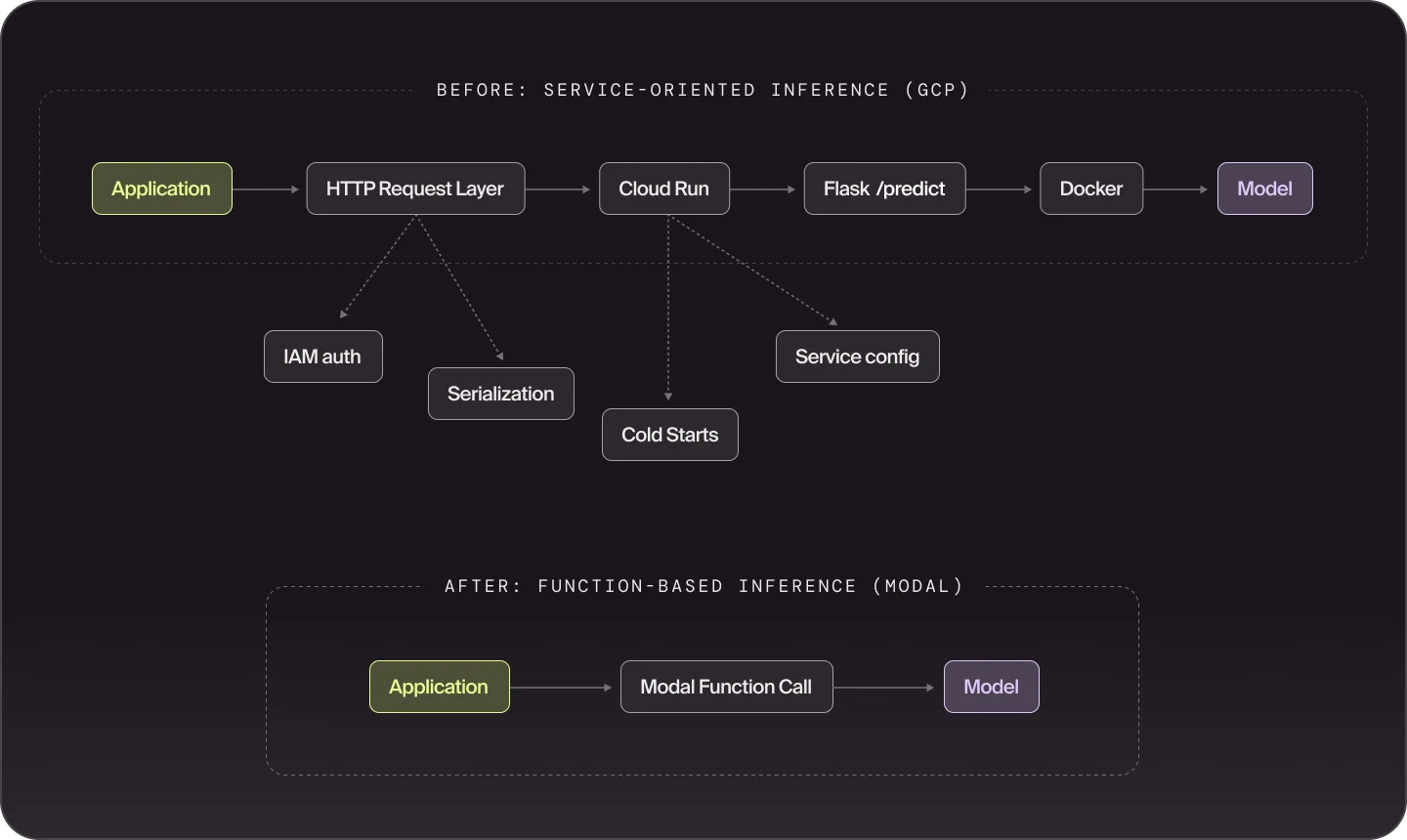
Before and after: service-oriented inference on GCP vs. function-based inference on Modal.
Message from Grant
As someone who has been subject to multiple impersonations online, I can vouch for how valuable it is for something like Doppel to exist. Also, the problem they've taken on, reliably crawling the entire web to detect social engineering attacks, is incredibly hard when you stop to think about it.
While visiting Doppel's offices, I had an enlightening conversation with their CTO, Rahul Madduluri. Every software company is grappling with a new reality for how software can be written. When code can be produced quickly, and when it's possible to generate it without understanding it, there are obvious potential pitfalls for anyone who cares about the long-term robustness of a codebase. Rahul had a refreshingly nuanced take on principles for how to get the most out of new tools while improving, not degrading, the cleanliness and robustness of a codebase.
I think this reflects a generally nuanced and clear-eyed take they have on AI and how best to use it. They don't just blindly lean on LLMs and deep learning alone, for example. I enjoyed learning about their underlying threat model, built on a Bayesian network, which is a structure that lends itself much more readily to interpretation and to baking in causal influence. There was generally a strong positive energy, with everybody genuinely enthusiastic about the piece they were working on.