Cognition

About
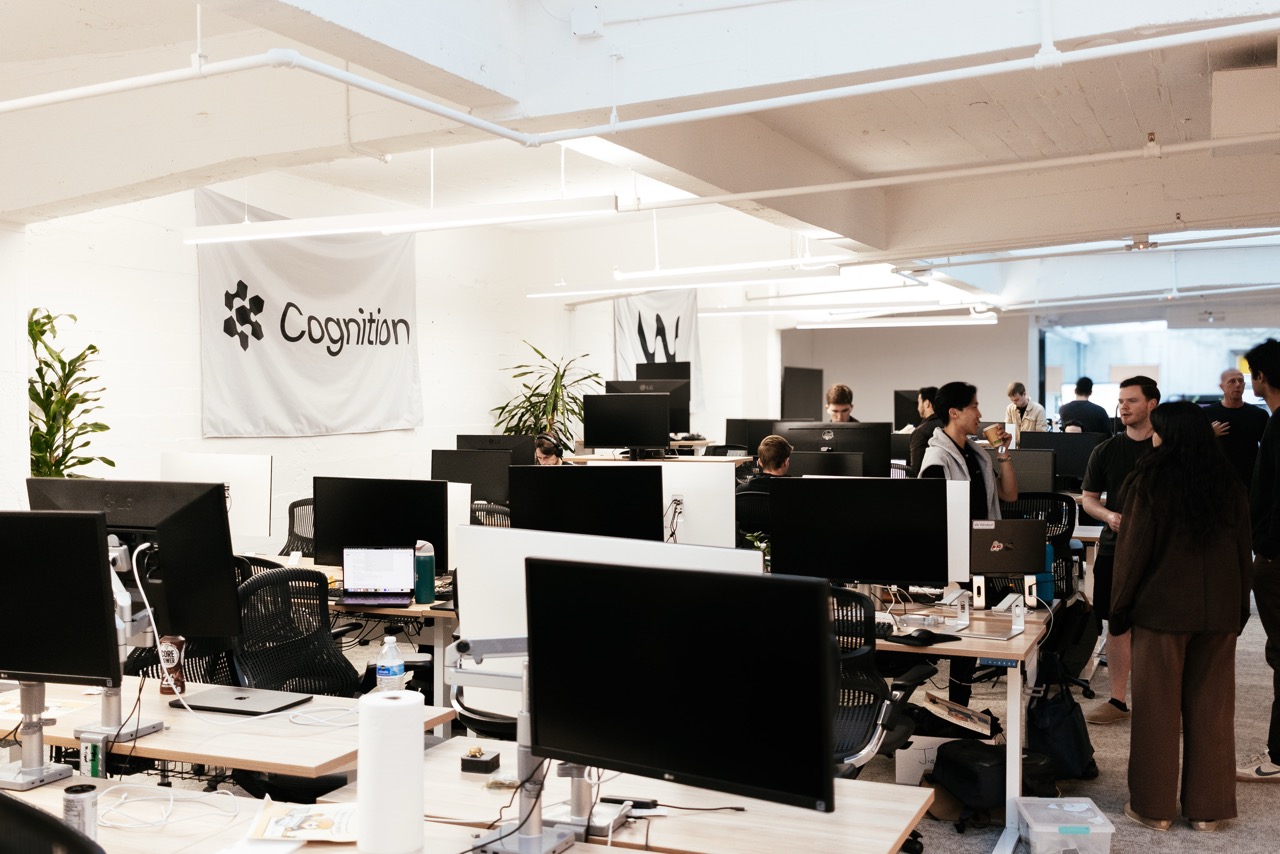
Our team is small and talent-dense. The founding team holds 10 IOI gold medals and includes leaders and builders who have worked at the cutting edge of applied AI at companies like Google DeepMind, Scale AI, Cursor, Lunchclub, Modal, Waymo, and Nuro. Of our initial ~35 team members, 21 of them had founded a company.
Wer'e developing a suite of agentic tools - led by Devin, our AI software engineer - that operate across the entire software lifecycle. Our mission is to create agents that can reason, remember, and execute complex work over long horizons, as true teammates to human engineers.
We're still in the early innings - our hardest challenges lie ahead. If you're excited to solve some of the world's biggest problems and build AI systems that can reason and learn, we'd love for you to explore our careers.
- Cloud Agents and the Cognition Platform Play, Why We Win the Enterprise
- I Spent December Seeing the Future. Then I Joined It.
- A Cheeky Pint with Cognition CEO Scott Wu
- Devin's 2025 Performance Review
- Eventually, The Future Comes
- Scott Wu (Our CEO) on How I AI Podcast
- The Future of Software Engineering: Cognition's Russell Kaplan
- Why Cognition Wins Deals 10x Our Size
- Introducing SWE 1.6 - Our Latest Model
- Our Use Case Library
- Our Customer Stories Page


A challenge for the 3blue1brown audience
At Cognition, we value people who not only solve hard problems but who can also identify key insights and explain them clearly to others.
For this challenge, start by reading our SWE-1.7 post, which covers how we trained our latest coding model. Pick one of these two mechanisms and create a brief visual explanation of the core insight that makes it work:
Entropy collapse and top-p sampling: Why does penalizing a single low-probability token during RL end up sharpening the entire distribution, not just suppressing that token? Compressed weight-delta broadcasting: How do we keep globally distributed inference clusters in sync with a training cluster without re-sending the full model each time?
Your visual explanation could be an animation, a diagram, or an interactive, together with a concise and clear written description. When you apply, in the section asking you to share specific achievements and experiences, include a line saying "My answer to the 3b1b Talent challenge" with a link to your result.
From the Founders
Exceptional outcomes are accomplished by small teams of highly technical people.
— Russell Kaplan, President
We love code... teaching AI to code has become our ultimate passion. And we're just getting started."
— Scott Wu, CEO
The Hard Problem We're Solving
Modern software development isn't a sequence of isolated keystrokes, but a multi-stage process that spans understanding existing systems, planning changes, writing and reviewing code, testing, documenting, and maintaining software over time. Our goal is to build AI teammates that can operate across this entire lifecycle, not just assist at a single step.
That's why Cognition is built as an agent lab: a place where research and engineering come together to develop a shared "agent brain" that powers a suite of products across the SDLC. This includes Devin, an autonomous software engineer; Windsurf, a next-generation IDE for creative 0-to-1 coding; Devin Review, which brings deep, contextual reasoning into code review; and DeepWiki, which helps teams understand and plan changes in large, complex codebases.
Our approach centers on pushing agent capabilities further along three dimensions:
- Long-horizon planning and reasoning, where agents construct and adapt multi-step strategies before and during execution - not just react to the next prompt.
- Deep, persistent codebase understanding, enabling agents to build a mental model of large systems, recall prior decisions, and reason about tradeoffs across files, services, and time.
- Autonomous execution with feedback loops, where agents write code, run tests, review changes, and iterate within real engineering environments and workflows.
By grounding these capabilities in real developer tools and workflows, we're building agents that don't just generate output - they do work.
We envision a future where engineers collaborate with a fleet of AI teammates that deeply understand their code, their tools, and their goals - freeing humans to focus on architecture, creativity, and the hardest problems, while agents handle execution at scale.
Featured Work
SWE 1.6 reflects how we think about building AI that actually works in practice - not just on benchmarks, but in the moment-to-moment experience of using it.
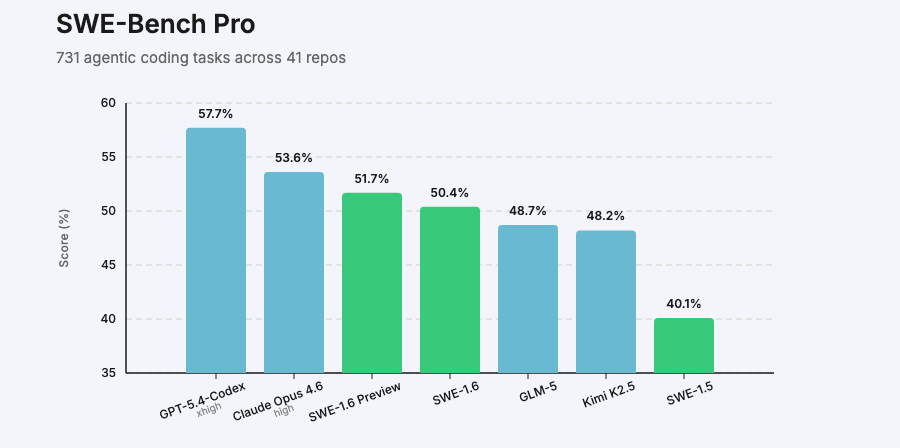
SWE 1.6 was post-trained from scratch to eliminate inefficiencies - bloated trajectories, sequential tool calls, and unnecessary terminal reliance. A length penalty in training was key: it discourages overthinking without sacrificing capability, pushing the model toward parallel tool use and faster context retrieval. The result: solve rates hold steady while assistant turns stay flat. Less friction, same intelligence.
That kind of disciplined tradeoff doesn't happen by accident. Internally, this translates into a culture that values:
- systems thinking over surface-level hacks,
- fast iteration paired with technical rigor,
- and building tools we ourselves rely on every day.
SWE 1.6 proves you don't have to choose between speed or craft - and that belief shapes how we build.
Read More About SWE 1.6Join
What I love about Cognition is the urgency. We're racing to build the future of software engineering, and everyone here feels that weight and excitement. It's intense, but when you see Devin or Windsurf solve problems you didn't think were possible yet, it's the most fulfilling thing in the world
— Theodor Marcu, Head of Product Growth
Cognition is a small, talent-dense team with a deeply competitive, low-ego culture. People move fast, argue passionately about hard problems, obsess over details others ignore, and take pride in making complex systems work at scale. If this sounds like you, we'd love to hear from you!
Message from Grant
I visited the nascent Cognition team not too long after it was founded a few years ago. What immediately struck me was the sheer concentration of both talent and hustle. It's filled with former founders and IOI/IMO medalists, everyone speaks highly of all their coworkers, and they're all working incredibly hard. The closest analogy I could think of was that it's the engineering equivalent of a team of athletes training for the Olympics.
I knew about them because a college friend of mine, Russell Kaplan, is their president. Throughout the last decade, Russell has had an uncanny ability to predict the major trends in AI a few years before they become mainstream. He's also one of the most savvy and ambitious people I know, so when he pointed his attention towards this new company, I was intrigued.
I've come back to meet the team a few times over the last year in the context of this partnership with 3b1b. Although it's grown a lot since that first visit (gone are the days of everyone coding away in a single shared house), I was pleased to see that through their growth, the talent concentration remains as dense as ever.