0xPARC
%20--%3e%3cdefs%3e%3cstyle%3e%20.st0%20{%20fill:%20none;%20}%20.st1%20{%20fill:%20%23ffffff;%20}%20.st2%20{%20fill:%20%2356479d;%20}%20.st3%20{%20fill:%20%2300aeef;%20}%20.st4%20{%20fill:%20%23de9ec6;%20}%20.st5%20{%20fill:%20%23fbb040;%20}%20.st6%20{%20fill:%20%23e7b0d1;%20}%20%3c/style%3e%3c/defs%3e%3cpath%20class='st1'%20d='M903.4,387.5c0-119.6,43-183,123.1-183s123.1,63.4,123.1,182.1-43.5,181.4-124.3,181.4-122-62.2-122-180.5h0ZM1096.2,388.6c0-87-25.4-137.5-71.1-137.5s-68,47-68,132.8,24.5,138.7,70.1,138.7,68.9-49.3,68.9-134h0Z'/%3e%3cpath%20class='st1'%20d='M1322.8,469.4l-65.9,93h-66.8l98.6-129.4-100.2-131.4h68.9l64.3,90.9,63.4-90.9h66.8l-96.7,126.8,102.3,134h-69.5l-65.2-93h0Z'/%3e%3cpath%20class='st1'%20d='M1784.2,309.2c0,65.5-49.5,112-121.7,112h-86.3v141.2h-56.7V204.4h149.3c70.1,0,115.5,41.9,115.5,104.8h0ZM1727,312.4c0-33.8-23.6-55.3-59.7-55.3h-90.9v111.5h88.4c38.2,0,62.2-21.6,62.2-56.2Z'/%3e%3cpath%20class='st1'%20d='M2023.4,476.1h-161.5l-32.2,86.3h-60.4l139.6-358h69.2l139.6,358h-61.8l-32.4-86.3h0ZM2003.5,423.3l-60.9-163.6-60.9,163.6h121.7Z'/%3e%3cpath%20class='st1'%20d='M2401.3,562.4l-92.1-147.2h-71.1v147.2h-56.2V204.4h143.7c70.1,0,117.5,41.4,117.5,101.8s-30.1,86.3-75.7,98.2l99.3,158h-65.5,0ZM2386.5,308.3c0-31.2-22.9-51.1-57.8-51.1h-90.5v106.9h84.9c37.3,0,63.4-23.2,63.4-55.7h0Z'/%3e%3cpath%20class='st1'%20d='M2769.5,433.5h57.2c-4.1,83.3-68.9,138.1-156.9,138.1s-174.3-77.8-174.3-189.8,68.9-185.6,176.4-185.6,145.1,48.6,153.4,124.8h-57.8c-5.1-43.5-45.6-72.2-97.7-72.2s-117.1,52.8-117.1,131.9,44.9,136,117.1,136,95.1-30.1,99.8-83.3h0Z'/%3e%3crect%20class='st4'%20x='411'%20y='215.7'%20width='12.9'%20height='485.2'%20rx='2.2'%20ry='2.2'%20transform='translate(-119.7%20148.8)%20rotate(-17.7)'/%3e%3cpath%20class='st2'%20d='M700.8,597.2l-217.3-420.6c-1.6-3.1-.4-7,2.8-8.6h0c3.2-1.6,7-.4,8.6,2.8h0c0,0,217.4,420.5,217.4,420.5,1.6,3.1.4,6.9-2.6,8.6h-.2c-3.1,1.8-7.1.6-8.7-2.6Z'/%3e%3crect%20class='st6'%20x='598.5'%20y='441.4'%20width='232.9'%20height='12.9'%20rx='2.2'%20ry='2.2'%20transform='translate(-119%20575.6)%20rotate(-40.8)'/%3e%3crect%20class='st3'%20x='354.1'%20y='360.7'%20width='488.4'%20height='12.9'%20rx='2.2'%20ry='2.2'%20transform='translate(-2.8%20729.7)%20rotate(-62.6)'/%3e%3cg%3e%3cline%20class='st0'%20x1='489.4'%20y1='65.6'%20x2='346.2'%20y2='519.1'/%3e%3crect%20class='st5'%20x='173.5'%20y='285.8'%20width='488.4'%20height='12.9'%20rx='2.2'%20ry='2.2'%20transform='translate(13.3%20602.7)%20rotate(-72.5)'/%3e%3c/g%3e%3crect%20class='st3'%20x='444.6'%20y='3.2'%20width='12.9'%20height='383.4'%20rx='2.2'%20ry='2.2'%20transform='translate(167.9%20596.5)%20rotate(-78.2)'/%3e%3crect%20class='st2'%20x='227'%20y='316.2'%20width='12.9'%20height='119.7'%20rx='2.2'%20ry='2.2'%20transform='translate(-143%20608.7)%20rotate(-89.9)'/%3e%3cg%3e%3cline%20class='st0'%20x1='270.9'%20y1='593'%20x2='691.5'%20y2='377.1'/%3e%3crect%20class='st5'%20x='238.2'%20y='478.3'%20width='485.8'%20height='12.9'%20rx='2.2'%20ry='2.2'%20transform='translate(-168.3%20273.2)%20rotate(-27.2)'/%3e%3c/g%3e%3c/svg%3e) Apply
ApplyAbout
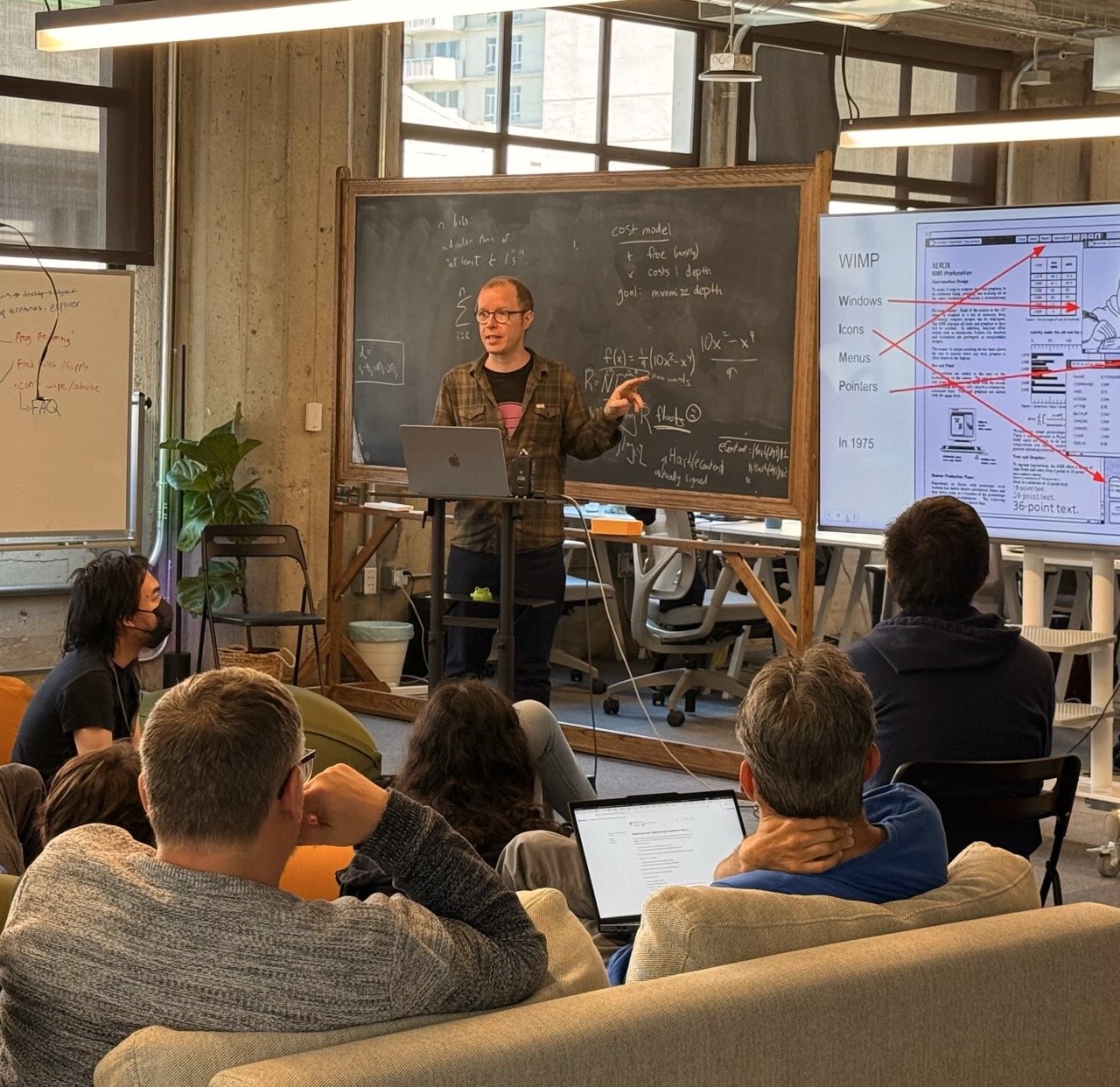
At 0xPARC, we strive to envision, invent, and improve the digital ecology of the future. Our efforts center around advancing the frontier of combining computing and mathematics, since we believe what makes a computer truly powerful is not just how fast it runs, but what it is capable of doing. It's easier to describe what we aren't than what we are, but it may help to think of 0xPARC as a grant-funded research organization and extended community of explorers whose activities include research, prototyping, engineering, and productionization.
Challenges for the 3blue1brown audience
A lot of pure math problems, often the kind that would arise in a contest math setting, are very relevant to the work we do. The first of these problems has a surprising connection to lattice-based cryptography and fully homomorphic encryption.
P1: Suppose I have a secret list of positive integers: (v_1, v_2, ..., v_n). You can't see my list, but you can ask me dot product questions. Give me any list of numbers (x_1, x_2, ..., x_n) of the same length, and I'll tell you x_1 \cdot v_1 + x_2 \cdot v_2 + ... + x_n \cdot v_n. Figure out my secret list using as few questions as possible.
Curious to see how this problem has surprising connections to lattice-based cryptography and fully homomorphic encryption? Learn more here.
These next problems, assembled by 0xPARC’s Holden Mui, come in pairs. The first problem comes from the contest math world, while the second problem comes from our work.
P2: Suppose you have many black-box majority functions on three binary inputs. Is it possible to chain them to construct a majority function on 2025 binary inputs? You can duplicate inputs and outputs of the black-box function for free. (From TST 2018/4)
P3: The CKKS fully homomorphic encryption scheme gives a way to encrypt vectors in {C}^{32{,}768} such that anyone can add encrypted vectors elementwise, multiply encrypted vectors elementwise, or "rotate" ciphertexts \left(z_1, z_2, \ldots, z_{65536}\right) \mapsto\left(z_i, z_{i+1}, \ldots, z_{i-1}\right) by any "offset" i. Suppose that:
- encrypted addition takes 4 microseconds
- encrypted multiplication takes 5600 microseconds
- encrypted rotation takes 6100 microseconds
Find a fast arithmetic circuit that computes the Fourier transform on an encrypted vector, conditioned on the multiplicative depth of the circuit being at most three.
P4: Are there any nontrivial solutions to the system of equations
\begin{align*}
a+b+c+d &\equiv 0 \quad(\bmod p) \\
a^2+b^2+c^2+d^2 &\equiv 0 \quad(\bmod p) \\
a^3+b^3+c^3+d^3 &\equiv 0 \quad(\bmod p)
\end{align*}
for p=2^{127} - 1?
P5: The programming language circom allows users to prove that they have an assignment to a set of variables satisfying a system of quadratic constraints
\begin{aligned}
(\text{lin. comb. of vars}) \times (\text{lin. comb. of vars}) &\equiv (\text{lin. comb. of vars}) \quad (\bmod p) \\
(\text{lin. comb. of vars}) \times (\text{lin. comb. of vars}) &\equiv (\text{lin. comb. of vars}) \quad (\bmod p) \\
&\vdots \\
(\text{lin. comb. of vars}) \times (\text{lin. comb. of vars}) &\equiv (\text{lin. comb. of vars}) \quad (\bmod p) \\
\end{aligned}
without revealing the complete assignment of variables. Some of the variables are set to be public, Some of the variables are set to be public, and the rest are set to be private
(a) Give a system of quadratic constraints in private variables x, s_1, s_2, s_3, \ldots that has a satisfying solution if and only if x \in\left\{0,1, \ldots, 2^{64}-1\right\}.
(b) Give a system of quadratic constraints in private variables x, s_1, s_2, s_3, \ldots that has a satisfying solution if and only if r \ne 1.
(c) Give a system of quadratic constraints in one public variable n \in\left\{2,3, \ldots, 2^{64}-1\right\} and private variables s_1, s_2, s_3, \ldots such that finding a satisfying solution to the system of quadratic constraints is equivalent to finding a nontrivial factorization of n.
(d) Give a system of quadratic constraints in 64 public variables \ell_0, \ell_1, \ldots, \ell_{63} \in\left\{0,1, \ldots, 2^{64}-1\right\} and private variables s_1, s_2, s_3, \ldots such that finding a satisfying solution to the system of quadratic constraints is equivalent to finding a nontrivial factorization of \ell_0+2^{64} \ell_1+2^{128} \ell_2+ \cdots+2^{4032} \ell_{63}.
If you can solve any of these, we'd love to hear from you.
Submit a solutionSelect Examples of Our Work
Pure Computing
In conventional systems, computing on data requires revealing the data to the party performing the computation. This comes with a permanent epistemic side effect in the form of the irreversible sharing of information. Pure Computing is computing without this side effect, akin to how a pure function executes with no side effects outside of the function's scope. Fully Homomorphic Encryption (FHE) enables computation over encrypted data, making Pure Computing mathematically possible.
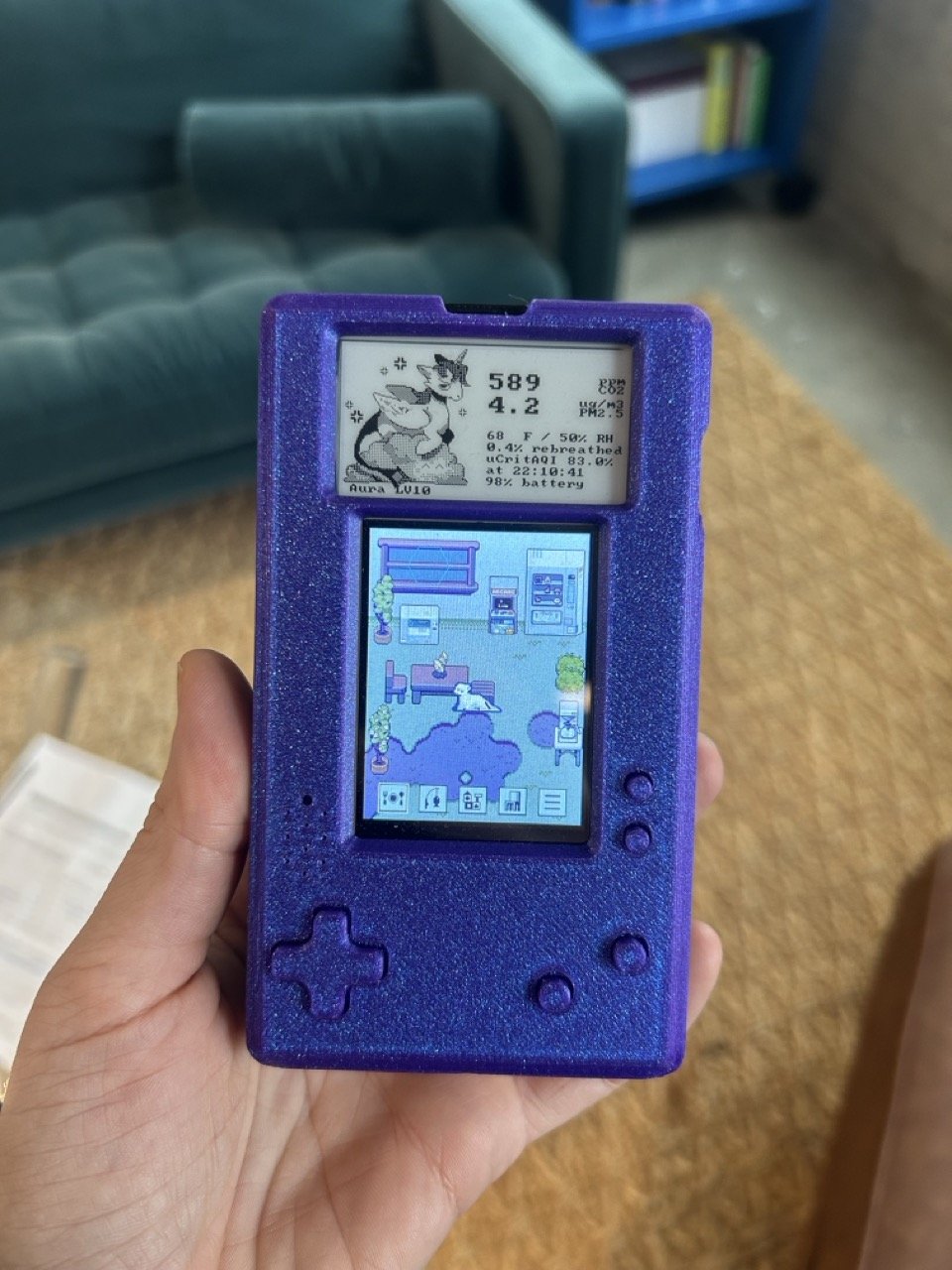
0xPARC is building an encrypted computing platform to bring Pure Computing from a mathematical possibility to being practical and accessible. By designing around for the strengths of modern GPUs, using kernel fusion, harnessing ideas from cryptography research and high performance computing systems, optimizing implementations of cryptographic schemes, and more, we've achieved performance orders of magnitude beyond naive implementations. The first real world deployment on top of the encrypted computing platform is an encrypted air quality monitoring network, where each air quality monitor's sensor data is immediately encrypted on-device, scientific computations run entirely on ciphertext, and raw data is never decrypted.
For more on the air quality monitoring network and how the encrypted computing platform works, check out this video presentation.
Digital Significance
A palimpsest carries its latest words, but also traces of past texts. A quilt made from clothes provides warmth, while also holding hints of the history of the garments it absorbed, and perhaps even the people who once donned them. Physical objects through their mere existence are self-evidently historical, valid, and thus significant. The opposite is true with conventional digital objects, made of strings of bits that are trivially copyable, history-free, and entirely dependent on external systems for meaning.
Recursive zero-knowledge proofs enable logic and history to accrue to a digital packet without requiring it to grow larger – compressing experience and capabilities into the packet, rather than appending it. 0xPARC's work on Provable Object Data harnesses this capability, along with other computing techniques and concepts, in order to be self-interpreting and self-evidently valid, by carrying their own statements, composition rules, and cryptographic anchors. This is part of our broader efforts and exploration of how independent digital objects can realize a level of significance we take for granted in the physical world, and perhaps more.
For more on Provable Object Data, see 0xparc.org/about-pod
More on Provable Object DataMessage from Grant
As I walked through their offices, the first thing that caught my attention was how the problem up on one of their whiteboards was one that I was actively making a video about (IMO P6 2025). If this isn't a strong signal of alignment between the kinds of people who work there and the 3b1b audience, I don't know what is.
While it's hard to sum up 0xPARC in a phrase, the answer I'd give is that it's a research lab focused on applied cryptography problems. The prototypical example in my mind based on our conversation, though it's not the only thing they work on, is that of fully homomorphic encryption (FHE). This is where you run computations on data without knowing anything about what that data represents. One example there would be multiple nations wanting to keep their satellites from colliding, but who, for various reasons, may not want to reveal where specifically their satellites are. I had always thought of FHE as being something which was theoretically pretty, but completely intractable in practice. Chatting with Albert Ni, though, I learned that's a bit of a misconception, and there are a lot of insights from both pure math and engineering to show how it's not as far out of reach as I thought.
I've always loved the math of cryptography, where you can often state problems that seem like they should be impossible, only to see that an elegant solution is just barely available with the right mathematical tools. It scratches exactly the same itch in my brain that good puzzles and brain teasers do. Moreover, the mathematical tools used in cryptography are beautiful! It's frankly just fun to see concepts usually reserved for the classrooms of a pure abstract algebra class in a university applied to tangible problems.