

About
Epoch AI is a research nonprofit investigating the trajectory and future of artificial intelligence. We are the creators of FrontierMath, a recognized AI benchmark made of research-level math problems.
We are now seeking problem contributors for FrontierMath: Open Problems, a new kind of AI benchmark consisting of unsolved math problems that have resisted serious attempts by professional mathematicians. AI solutions would meaningfully advance the state of human mathematical knowledge.
We have already launched the pilot and maintain a live scoreboard of open problems across fields like Combinatorics, Number Theory, and Topology, including notability ratings and "warm-up" versions for AI testing.
We think the 3b1b audience will be able to come up with some great problems!
Propose a problemThe Challenge
We are commissioning math problems that satisfy the following criteria:
- Open: No solution is known.
- Hard: At least two professional mathematicians have tried to solve it.
- Interesting: A solution would be worthy of publication in at least a standard specialty journal and would be at least somewhat likely to generate further new mathematics.
- Verifiable: Solutions can be verified to a high degree of confidence by a typical computer program (not Lean) running on a typical laptop in under an hour.
- Solvable: A verifiable solution should be likely to exist.
Next Steps
After you propose a problem, next steps typically consist of a brief back-and-forth about problem details, followed by us offering you a compensated contract to produce the full problem package, consisting of the following:
- Write-up explaining the problem's history and significance.
- Computer program ("the verifier") that evaluates candidate solutions, including supporting documentation and test cases.
- Precise problem statement ("the prompt") to be given to AI systems.
- Filling out a brief survey about the problem.
Compensation varies depending on how much work the package will be to produce. This is usually driven by the complexity of the verifier.
Watch Greg Burnham, lead of the project, present FrontierMath: Open Problems and explain why it matters. This was an internal chat held before the pilot was launched.
Solutions can be verified automatically
Evaluating AI solutions to unsolved math problems is a major logistical challenge. Math research typically proceeds via natural-language papers. Evaluating such papers is labor intensive and error-prone even for humans. While AI systems have made progress at evaluating natural-language mathematics, we cannot rely on the accuracy of their evaluations for advanced material (e.g., see here for work on AI systems grading prose proofs.) Our approach is to find problems where, even though no solution is currently known, a proposed solution can be checked by a relatively straightforward computer program running on a typical computer. It is not obvious that such verifiable problems exist, but they do:
- Some problems ask for a very concrete mathematical object, where the problem’s meaningfulness stems from the fact that a conceptual approach appears to be required to construct the desired object. One such case asks for a polynomial with a certain property (namely, a polynomial whose Galois group is the Mathieu group M23). It is quick to check if a given polynomial has the desired property, but finding one is beyond the reach of any known technique, including highly optimized, large-scale search.
- In other cases, we want a construction that works for all positive integers. We can’t verify this in general, but we can ask for an algorithm that takes an integer and returns a construction for that integer. We can verify the algorithm on a challenge set of integers where no constructions are currently known and where the integers are large enough that search is intractable. Success here gives strong evidence that the algorithm implements a general solution.
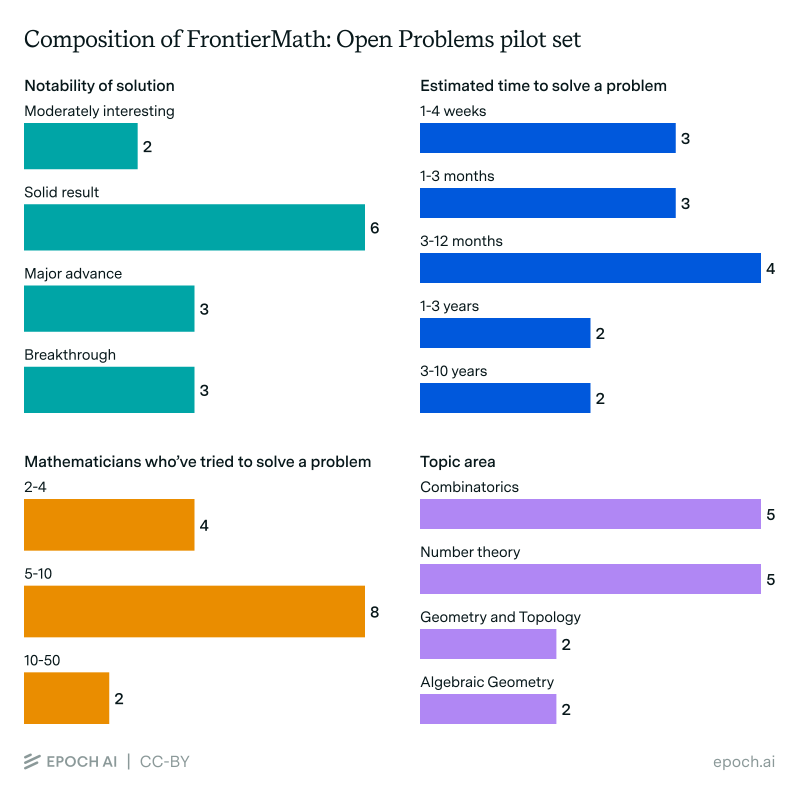
The downside is that this approach limits what we can ask about, but we have been pleasantly surprised by how readily mathematicians have been able to come up with a diversity of mathematically meaningful problems that satisfy this verifiability constraint. Problems in the pilot span a range of notability, estimated time to solve, number of mathematicians who’ve tried to solve, and topic areas:
For more context
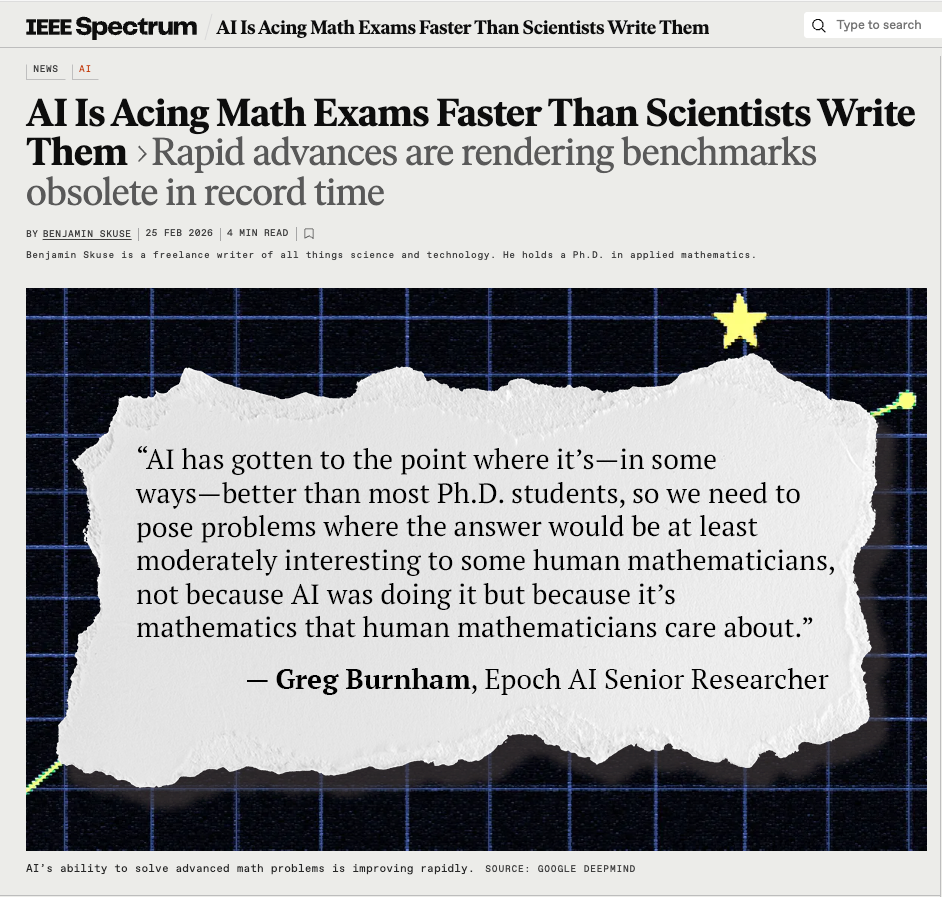
IEEE Spectrum recently interviewed project lead Greg Burnham, situating this new benchmark in relation to Epoch’s prior FrontierMath Tiers 1-4, as well as Aletheia and First Proof.
For a deeper dive into why this project matters, listen to Greg Burnham and Prof. Daniel Litt discuss the jagged frontier of AI math capabilities, including the value of "expert-level" problems that resist standard optimization:
- Questions: math@epoch.ai
- Submissions: Problem Proposal Form